







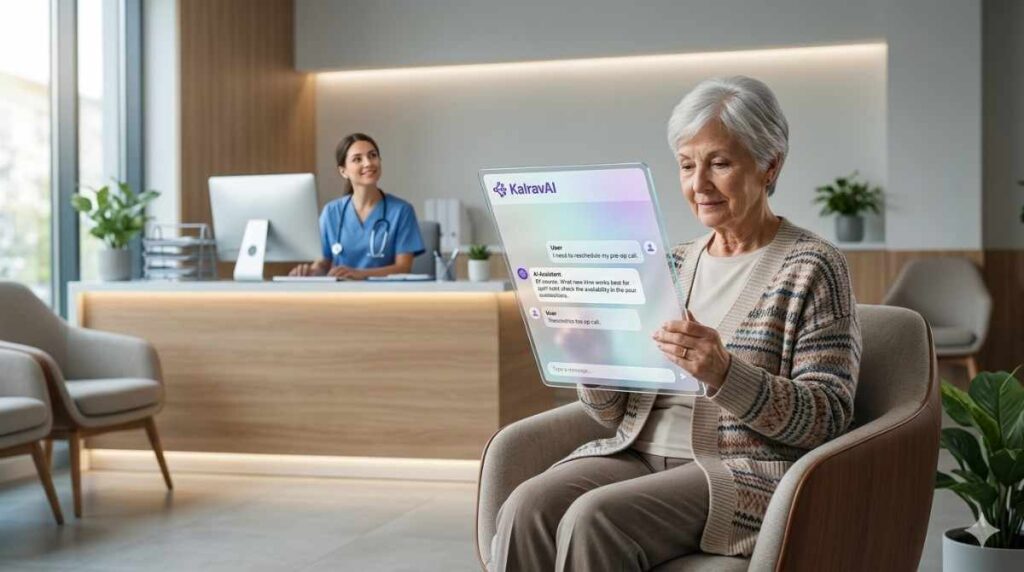
The healthcare industry is facing a dual crisis: unprecedented administrative burnout and rapidly rising patient expectations. Today’s patients don’t want to spend 20 minutes on hold just to schedule a routine check-up, and medical staff shouldn’t have to spend half their day manually data-entering patient details into a CRM.
Enter AI in patient engagement.
By deploying conversational, intelligent AI assistants, healthcare providers are bridging the gap between clinical efficiency and patient satisfaction. Here is how healthcare customer service automation is shifting from a futuristic luxury to a modern operational necessity.
1. 24/7 Patient Support Automation
Medical questions and administrative needs don’t stop when the clinic doors close at 5 PM. Intelligent AI assistants allow hospitals and private practices to offer 24/7 support.
Whether a patient needs to check post-operative care instructions at midnight or download a billing transcript, an AI agent handles the request instantly. This level of responsiveness reduces anxiety for the patient and drastically drops the morning call volume for the front-desk staff.
2. Frictionless Appointment & Scheduling Sync
One of the largest bottlenecks in healthcare administration is scheduling. A smart healthcare AI assistant can seamlessly integrate with internal practice management tools and databases to coordinate calendar bookings.
- Real-time Availability: Patients can check, book, reschedule, or cancel appointments dynamically through a simple chat interface. Irisidea TechSolutions
- Automated Triggers: The AI can send instant alerts, reminders, and preparation instructions (like fasting requirements before bloodwork), significantly slashing patient no-show rates.
3. Intelligent Data Capture and CRM Management
Patient onboarding often involves tedious paperwork. Conversational AI changes this by transforming cold static forms into interactive, friendly conversations.
As a patient chats with the AI agent, the system captures qualified intake data and securely syncs it in real-time with existing medical CRMs or databases (such as Zoho, Salesforce, or internal tools). This eliminates manual data entry errors and ensures that physicians have accurate, up-to-date patient profiles before the appointment even begins.
4. Secure, Empathetic, and Multi-Lingual Interactions
Modern conversational platforms are designed to feel native and accessible to everyone.
- Language & Dialects: Medical systems serve diverse communities. AI agents with multi-lingual capabilities ensure that language barriers don’t compromise care, speaking to patients in their preferred tongue. Irisidea TechSolutions
- Accessibility Support: For patients with low vision or blindness, advanced agents support voice commands and audio responses, making digital health portals genuinely inclusive. Irisidea TechSolutions
- Data Masking: Top-tier enterprise systems utilize robust PII (Personally Identifiable Information) and PHI (Protected Health Information) masking, ensuring that sensitive medical data remains strictly secure and compliant with global frameworks. Kalrav.ai
5. Seamless AI-to-Human Handoff
While a healthcare AI assistant can confidently resolve up to 80% of routine inquiries—such as directions, scheduling, and general FAQs—complex clinical triage will always require human expertise.
The true power of modern AI lies in its ability to execute a smooth handoff. When a query exceeds the AI’s parameter guidelines, it transitions the conversation to a live medical representative or creates a secure support ticket automatically, passing along the full conversation transcript so the patient never has to repeat themselves.
[Patient Query] ──> [AI Agent Handles FAQs/Scheduling] ──> [Complex/Clinical Need?]
                                                                 │
                                                ┌────────────────┴────────────────┐
                                                ▼                                 ▼
                                        [Yes: Smooth Human Handoff]       [No: Instant Resolution]
Implementing AI in patient engagement isn’t about replacing the human touch in medicine—it’s about scaling it. By automating repetitive administrative burdens, healthcare systems give their medical staff the breathing room to focus entirely on what matters most: direct patient care.
FAQ
What is AI in patient engagement?
It refers to using intelligent conversational AI agents to automate healthcare customer service, answer medical questions, and guide patient interactions 24/7.
Can a healthcare AI assistant schedule patient appointments?
Yes, advanced AI assistants sync directly with medical calendars and CRMs to handle real-time bookings, cancellations, and automated reminders.
How does patient support automation protect sensitive medical data?
Enterprise AI systems keep medical data secure by using end-to-end data encryption and strict Personally Identifiable Information (PII) and Protected Health Information (PHI) masking.
What happens if a patient asks the healthcare AI a complex clinical question?
The system initiates a seamless AI-to-human handoff, instantly routing the complex query and the full conversation transcript to a live medical professional.
Does a healthcare AI assistant support multiple languages?
Yes, modern agents offer native multi-lingual and regional dialect capabilities to ensure clear communication with diverse patient communities